Every tank water heater collects sediment. As water heats, the minerals dissolved in it (mostly calcium and magnesium) come out as fine grit and settle on the bottom of the tank. Over a few years that layer can be several centimetres deep, and it sits exactly where the heat has to get through.
Flushing the tank removes most of it. It takes about an hour, needs no special tools, and adds years to a water heater.
Signs you have sediment
- Rumbling, popping, or crackling when the heater runs. That is water trapped under the sediment boiling in small bursts.
- Hot water runs out sooner than it used to, because the grit takes up space and insulates the water from the burner or lower element.
- Hot water takes longer to recover between showers.
How often to flush
It depends on how hard your water is. Your water supplier publishes the hardness for your area.
- Soft water (under about 60 mg/l): every two to three years.
- Moderately hard water: once a year.
- Hard water (over about 180 mg/l), or if you can see limescale on taps: every six months.
What you need
- A garden hose long enough to reach a floor drain or outside
- A flat-head screwdriver or adjustable spanner, depending on the drain valve
- A bucket, to check what is coming out
- Gloves and old towels
- About an hour, with no one needing hot water
Hot water and empty tanks
The water in the tank is hot enough to scald. Turn the heat off and, if you can, wait two hours or run the hot taps until the water cools before you open the drain valve. On an electric heater, never switch the power back on until the tank is completely full: an element that heats with no water around it burns out within seconds.
Flushing the tank, step by step
Turn off the heat
On an electric heater, switch it off at the isolator or the breaker. On a gas heater, turn the gas control to “pilot” (or to “off” if you are not comfortable relighting it later), so the burner cannot fire while the tank is emptying.
Turn off the cold supply
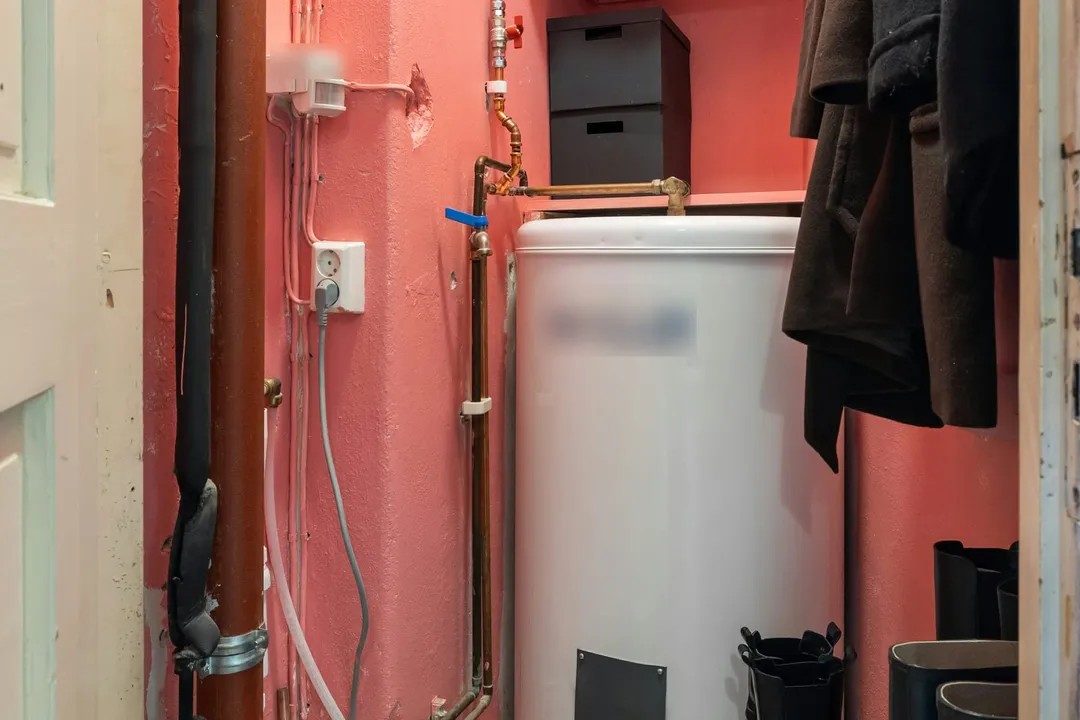
Close the cold water valve on the pipe going into the top of the heater. This stops the tank refilling while you drain it.
Connect the hose to the drain valve
The drain valve is near the bottom of the tank. Screw the hose on firmly and run the other end to a floor drain, a gully outside, or a bucket you can empty. Keep the hose lower than the valve along its whole length.
Open a hot tap
Open the nearest hot tap in the house. This lets air into the system so the tank can drain; without it, the water barely trickles out.
Drain the tank
Open the drain valve. Catch the first few seconds in the bucket to see what comes out, then let the tank empty through the hose. A typical tank takes 20 to 40 minutes.
Flush until it runs clear
With the drain valve still open, open the cold supply for a minute or two to stir up the sediment on the bottom and push it out. Close it, let the tank drain, and repeat until the water from the hose runs clear with no grit.
Refill before you turn the heat on
Close the drain valve and remove the hose. Open the cold supply and let the tank fill. Leave the hot tap open until water comes out of it in a steady stream, with no spitting air, then close it. Only now switch the power back on, or turn the gas control back to “on” and relight the pilot if needed.
Check the drain valve
Check the drain valve after an hour and again the next day. A drip usually means a bit of grit is caught in the seat: open and close it once more to flush it through. If it keeps dripping, fit a brass cap on the hose thread and book a valve replacement.
When not to flush it yourself
If the heater is more than about ten years old and has never been flushed, think twice. Years of sediment can be the only thing sealing a corroded tank bottom, and old plastic drain valves often do not reseal once they have been opened. In that case, flushing can turn a heater that works into one that leaks. Have a plumber look at it first.
Do not flush a tankless (combi or on-demand) water heater this way. It has no tank to collect sediment; instead, scale builds up inside the heat exchanger, and it needs descaling with a pump and a descaling solution through its service valves, following the maker’s instructions.
If your heater rumbles even after a flush, or the drain valve will not stop dripping, call us. Our water heater repair service covers flushing, drain valves, elements, and anode rods, and for on-demand units we do tankless water heater descaling and servicing.
Written by
Marco D.
Lead service plumber
Leads service calls in Elm Park and writes the repair checklists the plumbers work from.